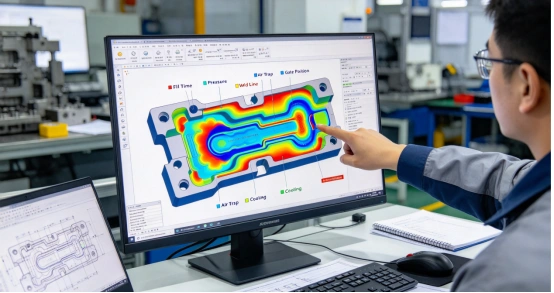
Mastering the Art of Precision: 10 Critical Pillars of High-Performance Injection Molds
Introduction
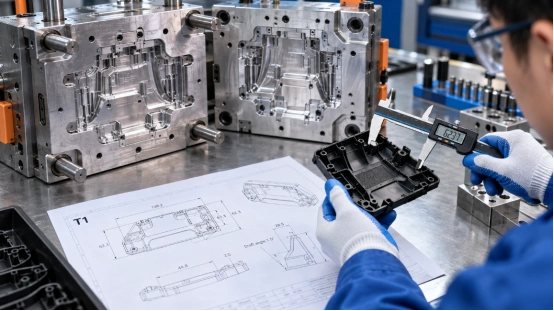
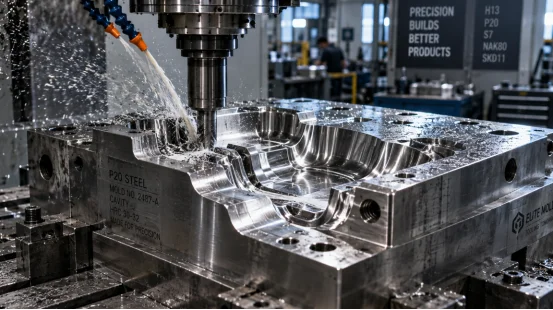
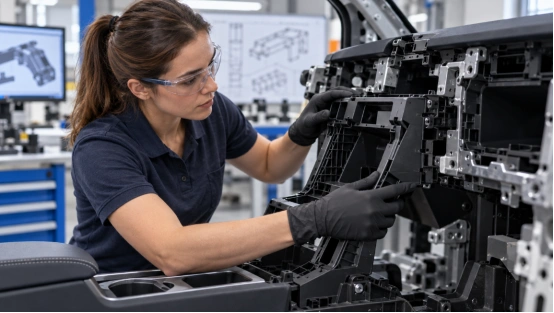
In the world of injection molding, a mold is far more than just a piece of steel. It is the heart of production. A poorly designed mold leads to endless downtime, high scrap rates, and wasted costs. At XinkeyMould, we believe that excellence is found in the details. Today, we’re taking you behind the scenes to explore the “Matrix of Excellence” that defines a high-quality mold.
1. The Foundation: Mold Flow & Steel Selection
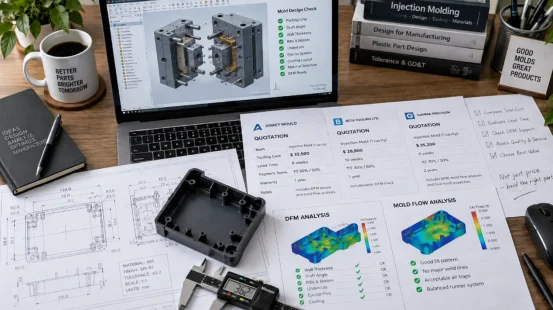
Success begins before the first cut is made. We use advanced Mold Flow analysis to predict potential issues like warping or air traps. Combined with the right Mold Steel, we ensure that your mold isn’t just precise, but durable enough for millions of cycles.
2. Precision in Motion: Sliders, Lifters, and Ejection
https://youtu.be/hqnWm2AldiU
Complex geometries require flawless movement. Our engineering team specializes in optimized Slider and Lifter designs to handle undercuts with zero friction issues. Combined with a balanced Ejection system, we ensure parts are removed smoothly without distortion or stress marks.
3. Thermal Control: Cooling & Hot Runners
Cycle time is money. By designing intelligent Cooling channels and integrating high-performance Hot Runner systems, we minimize thermal stress and maximize production efficiency. Our goal? The fastest cycle time without compromising part integrity.
4. Eliminating Defects: Air Venting & Surface Integrity
Small details prevent big headaches. Proper Air Venting prevents burning and short shots, while meticulous attention to parting lines eliminates Flash/Burr. We treat every Flow Mark and Welding Line as a challenge to be solved through gate optimization and pressure control.
A Great Mold is a Silent Asset. It runs consistently, day and night, producing perfect parts every time. From Cavity/Core precision to the final surface finish, XinKeyMould is your partner in engineering excellence.
READ MORE
Engineering High-Efficiency Molds for Industrial Packaging
In industrial packaging—specifically for 5L to 20L pails and buckets—the game is won or lost in the cycle time. If your 20L pail takes 42 seconds to cool while your competitor’s takes 40, you are losing money on every single shot. Over a million-unit run, those two seconds represent a small fortune.
At Xinkey, we utilize our 750T injection capacity and specialized packaging engineering to help our clients dominate their markets. Here is how we build “profit-generating” molds for the packaging industry.
Cooling Geometry: The Heart of Speed Standard molds use basic cooling lines. For high-speed pails, we design complex, conformal cooling circuits that wrap around the deep-cavity cores. We use specialized materials with high thermal conductivity in the areas that hold the most heat (like the gate and the bottom rim). The result? Faster heat dissipation and a cycle time that is consistently 10-15% faster than standard tooling.
Thin-Wall Strength: Fighting the “Bulge” Industrial buckets need to be light enough to save on resin costs but strong enough to stack four-high in a hot warehouse. We focus on wall-thickness consistency. Even a 0.05mm variance across a large bucket can cause it to tilt or fail under load. Our precision CNC machining ensures the core and cavity are perfectly centered, giving you a balanced part that passes every drop test.
Built for the Long Haul Packaging molds run hard—24 hours a day, 7 days a week. We build our pail molds using premium, hardened steels like H13 or 1.2344, treated to withstand the high-velocity friction of rapid injection. Our molds are designed for “easy maintenance,” meaning wear parts can be swapped out on the floor without taking the whole mold back to the shop.
Xinkey’s Packaging Promise: Whether you need a heavy-duty chemical pail or a high-aesthetic food container, we provide the 750T scale and the engineering depth to make your production line more efficient. We don’t just build a bucket mold; we build an edge for your business.
READ MORE
Why We Don’t Cut Steel Without Moldflow Anymore
Let’s be honest: in the injection molding world, “fixing it later” is a nightmare scenario. If you wait until the mold is on the press to find a massive sink mark or warpage, you’ve already lost the battle. The costs of recutting steel and the delays in shipping can kill a project’s ROI.
That’s exactly why Moldflow isn’t just a “fancy tool” for us—it’s our insurance policy. Here’s why it’s non-negotiable for any serious project.
1. No More “Guessing” at Defects
We’ve all been there: a part looks great on CAD, but the physical sample comes out with a nasty weld line right across a visible surface. Moldflow lets us “see the invisible” before we even touch the tool. We’re talking about spotting air traps, short shots, and sink marks while the design is still digital. Fixing a 3D model takes minutes; fixing a hardened steel mold takes weeks (and thousands of dollars).
2. Nailing the “T0” Success
The goal is always a perfect T0 trial. To get there, you need more than just a good guess on gate placement. We use simulation to stress-test different scenarios: What if we move the gate 5mm? How does the cooling layout affect cycle time? By finding the optimal “process window” early, we save our customers from the endless loop of trial-and-error during mold sampling.
3. Staying “Steel-Safe”
Predicting shrinkage and warpage isn’t just a math exercise—it’s about staying “steel-safe.” There is nothing worse than getting your first samples back only to realize the part warped so badly it’s out of spec, and you’ve already cut away all the metal. Moldflow lets us build in those offsets early. It saves you from that mid-project heart attack when you realize the mold is “bricked” and requires expensive welding or a total rebuild just to get a usable dimension.
4. Shot-to-Shot Consistency
Look, anyone can get lucky and pull a decent first sample. But consistency over a 100,000-part run? That’s the real test. If your cooling isn’t uniform or your fill isn’t perfectly balanced, you’ll be “chasing dimensions” for the entire production life of the tool. Moldflow helps us iron out these kinks by ensuring every cavity behaves exactly the same. Whether it’s the 1st shot or the 50,000th, the part needs to fit—especially in high-precision assemblies where a few microns are the difference between a success and a reject.
5. Data Over “Gut Feelings”
We’ve all sat in meetings where three different people had three different “gut feelings” about where the gate should go. Experience is vital, but physics doesn’t have an ego. Moldflow gives us a quantitative roadmap based on actual pressure gradients and thermal curves. It shifts the conversation from a subjective “I think this might work” to an objective “the data shows this will work.” It takes the guesswork out of the room so we can focus on engineering.
At the end of the day, Moldflow is your ultimate de-risking strategy. It’s about compressing those painful development cycles and making sure that when we finally hit the “Cycle Start” button on the press, we aren’t just crossing our fingers and hoping for the best. We aren’t gambling with your budget—we’re executing a plan that’s already been proven in a virtual environment.
READ MORE
The Art of the Parting Line: Why Mold Design is More Than Just Splitting a Part
In the world of injection molding, the parting line is never just a random “split.” It is the high-stakes intersection where engineering constraints meet aesthetic demands. A well-designed parting surface isn’t just functional—it’s elegant, easy to machine, and built for a million-cycle lifespan.
Getting it right requires a blend of cold engineering logic and years of “boots-on-the-ground” shop experience.
First, a Quick Refresher:
The Parting Surface: This is the “handshake” between the A-side (cavity) and B-side (core). It’s the primary interface that defines the tool’s geometry.
The Parting Line: This is the witness mark left on the final part. To an engineer, it’s a map of how the mold functioned; to a consumer, it should be as invisible as possible.
Our philosophy is simple: Optimize for demolding, simplify for machining, and design for and keep a sharp eye on the total cost of ownership.
Here is how we break down the parting line strategy.
Aesthetics & Precision: “The Invisible Witness”
In a perfect world, the parting line should be invisible. If the end user can catch a ridge with their fingernail or see a distracting flash, we’ve missed the mark on the DFM.
Bury the Mark: We keep parting lines off primary cosmetic surfaces. We prioritize hiding them in transitions, ribs, or decorative grooves. When hiding the line isn’t an option, we’ll often bake a decorative step or a “shadow line” into the design to camouflage the mismatch.
Concentrate Precision Features: Don’t split high-tolerance geometry—like mating steps or concentric bores—across both halves. Keep them on one side to avoid the inevitable headache of mold shift and tolerance stack-up.
Splitting them across the parting line introduces assembly errors and concentricity headaches.
Protect Functional Zones: Never run a parting line through a sealing surface or a precision thread. It’s a recipe for leaks and mechanical failure.
The Demolding Priority: “The Clean Release”
A part that hangs up in the tool is more than a nuisance—it’s a production disaster..
Hunt for the Widest Profile: We always split the mold at the part’s maximum cross-section. This ensures the part clears the steel without interference.
Ensuring the B-Side “Hug”: Since the ejection hardware lives on the moving half, the part needs to stay there when the mold cracks open. We pull this off by carefully balancing the draft and texture—intentionally making the part “grab” the core so it clears the cavity every single time.
Kill the Slides: Side-actions (sliders and lifters) add cost and complexity. We always look for ways to tweak the parting line to eliminate the need for side-pulls. If we must use them, we keep the travel distance short and the action on the B-side.
Manufacturability: “The Breathable Mold”
A mold that can’t breathe will fail. We use the parting line as the tool’s lungs.
Natural Venting: We strategically place the parting line at the end of the melt flow. This allows trapped air to escape naturally, preventing the dreaded “dieseling” or gas burns that ruin parts.
Managing Thin Geometry: Fighting wall thickness variation in thin parts often requires switching to a conical or interlocking “stepped” parting plane. This locks the tool geometry in place, keeping the nominal wall consistent and fighting the urge for the part to potato-chip (warp) during cooldown.
Tooling & CNC: Keep it Machinable
Complexity is the enemy of the mold maker.
Avoid the “Rollercoaster”: Whenever possible, we use flat parting planes. Twisted, multi-level parting surfaces might look cool in CAD, but they are a nightmare to CNC and even worse to “spot” (hand-fit) during assembly.
No “Thin Steel” Conditions: We avoid sharp corners or thin blades of steel near the parting line. These areas are prone to “chipping” or early wear, leading to flash and expensive repairs down the road.
Economics: “Fighting the Press”
The way we split the part directly affects the cost per piece.
Minimize the Footprint: We align the parting line to minimize the part’s projected area relative to the clamping direction. Lower projected area means lower required tonnage—meaning we can run your part on a smaller, cheaper press.
Standardize and Simplify: One main parting line is always better than three. The simpler the tool, the lower the maintenance cost and the higher the reliability.
The Bottom
At the end of the day, a parting line isn’t just a mark on a part—it’s a signature of the engineering quality behind it. Whether you are looking for medical-grade precision or high-volume consumer goods, how you split your mold defines your success.
READ MORE
Inside the Press: A Real-World Look at the Injection Molding Cycle
Introduction
In modern manufacturing, injection molding is the heavy hitter for high-volume, precision plastic parts. But for most designers, the magic happens behind closed steel doors. Understanding the mechanical “heartbeat” of the press is the first step toward a design that actually works on the shop floor, not just in a CAD simulation.
Here is how the cycle actually breaks down:
Step 1: The Lockdown (Clamping)
Before a single pellet of resin moves, the press has to secure the tool. We’re talking about massive force here—often hundreds of tons—to keep the A-side and B-side from blowing apart during the shot.
The Pro View: Don’t underestimate surface area. If you’re molding a part the size of a dinner plate, that internal pressure is fighting to force the mold open. Without enough “tonnage” (clamping force), you get flash—that messy plastic bleed that ruins your part’s edges.
Step 2: The Shot (Injection)
Once the tool is clamped tight, the screw drives forward. This isn’t just a simple fill; it’s a high-velocity ramming of molten resin through the nozzle and into the tool’s geometry.
The Hidden Challenge: Every mold cavity is already full of air. As the plastic slams in, that air needs an immediate exit strategy. This is why we obsess over venting. If that air gets trapped and compressed, it heats up instantly—causing “dieseling” or those ugly black burn marks on your finished part.
Step 3: The Wait (Cooling)
Fill is done. Now, the clock starts. Cooling is usually the “dead time” in the cycle, yet it accounts for roughly 70% of the total process time.
Physics at Work: We aren’t just letting it sit. We are aggressively pulling heat out via internal water lines.
The Design Reality: This is where uniform wall thickness becomes your best friend. If one section of your part stays hot while another freezes, the part will literally fight itself as it shrinks. The result? Sink marks or that dreaded warpage that sends parts to the scrap bin.
Step 4: Plasticizing – Prepping the Next Shot
The machine is a master multitasker. Even while the current part is still solidifying in the mold, the screw is already backing up to prepare for what’s next.
What’s actually happening: It’s chewing through raw pellets from the hopper, using a brutal combination of heater bands and pure mechanical shear friction to prep the next “shot.” We call this screw recovery, and getting the speed and back pressure right is the secret sauce for a consistent melt density.
Step 5: Ejection – The Moment of Truth
Once the part hits its target temperature and gains enough structural “backbone,” the mold cracks open.
The Release: This is where the ejector pins—those tiny mechanical fingers—shove the part off the core. If your draft angles aren’t spot on, you’ll hear a “crunch” or see drag marks that ruin a perfectly good finish. It’s the ultimate test of your tool’s design.
Injection molding isn’t just about pushing a button and watching parts fall into a bin. It’s a delicate balance of temperature, pressure, and timing. If you skip the DFM (Design for Manufacturability) stage, you aren’t just risking a bad part—you’re risking your entire production timeline.
Step 6: Post-Process – Part Recovery & The Runner Strategy
The machine’s internal cycle is over, but the work isn’t done until the part is shelf-ready. Whether it’s dropped into a collection bin or snatched by a robotic arm, the final stage is about separation and logistics. The Pro View: In a standard “cold runner” setup, your part comes out attached to a plastic “scaffolding” (the runner). We clip these off, and in a sustainable shop, those runners are immediately tossed into a granulator to be turned into regrind. This minimizes material waste and keeps your part cost down. The High-Volume Hack: If you’re running millions of units, we’d likely steer you toward a Hot Runner system. While hot runners demand more upfront capital, they streamline the process by bypassing the runner system entirely. You get zero scrap and a much leaner cycle time. After a quick weigh-and-count for accuracy, we box them up and get them moving—on their way to your facility without any unnecessary secondary Ops.
Got a complex design that’s giving you headaches? Don’t wait until you’re on the shop floor to find the flaws. Reach out to our team for a deep-dive DFM analysis, and let’s get your project running as smooth as a hot runner system.
READ MORE
The Engineering Secrets of High-Speed Automatic Unscrewing Molds
If you are manufacturing parts with internal or external threads—like pipe fittings, cosmetic caps, or industrial valves—you know that the “unthreading” phase is the biggest bottleneck in the injection cycle. In many standard shops, this is still done via manual unscrewing or slow, secondary operations.
At Xinkey Mould, we see threading not just as a feature, but as a mechanical puzzle to be automated. Here is why engineering an Automatic Unscrewing System is the best investment for high-volume threaded parts.
The Gear-Driven Heart: Rack and Pinion vs. Hydraulic Motors
The core of an unscrewing mold is its drive mechanism. There is no “one-size-fits-all” solution here.
Rack and Pinion: For high-speed, synchronized movements, we often design a rack-and-pinion system driven by the mold’s opening stroke. It’s purely mechanical and incredibly fast.
Hydraulic or Electric Motors: When the thread is too long or requires multiple rotations, we integrate precision motors.
The secret Xinkey has learned over 25 years? It’s the synchronization. If the core doesn’t retreat at the exact same rate as the thread pitch, you’ll strip the plastic threads before the part even leaves the mold. Our designers use 3D simulation to map this “travel-to-rotation” ratio to the micron.
Solving the “Friction” Nightmare
Threaded cores are constantly rotating against the mold cavity. This creates massive friction and heat. Standard mold shops often face “galling” (metal-on-metal seizing) after only a few thousand shots.
We solve this by choosing the right “muscle” for the mold. We use hardened H13 or S136 steel for the rotating cores, often treated with specialized low-friction coatings (like DLC). Furthermore, we design internal cooling channels inside the rotating core—a high-level engineering feat that ensures the plastic sets quickly and the threads stay crisp, shot after shot.
The ROI: Why “Cheap” Molds Cost You More
We often see clients come to us after buying a cheaper, manual unscrewing mold elsewhere. They saved $5,000 on the tool but are spending $2,000 every month on labor and scrap parts.
An automatic unscrewing mold from Xinkey might have a higher upfront cost, but it eliminates manual intervention. By shaving 5 seconds off a cycle and removing the need for a human operator, the mold usually pays for itself within the first few months of production.
The Xinkey Advantage
When you send us a 3D file for a threaded part, our 22 designers don’t just look at the shape. We look at the Pitch, the Material Shrinkage, and the Cycle Time. We build tooling that allows you to hit the “Start” button and let the machine do the work 24/7.
READ MORE