Low-Volume Injection Molding: On-Demand Production & Fast Tooling
23rd October 2026

 author
Short shot is one of the molding problems most factories will eventually run into, especially when producing thin-wall plastic parts or components with long flow distances. Sometimes the molding process looks completely normal, but the parts coming out of the mold are still not fully formed. You may see missing edges, incomplete features, or areas where the plastic never reaches the end of the cavity. This kind of defect usually means the molten material lost its ability to flow before filling the entire mold. As the plastic cools, it starts to freeze inside the cavity, blocking the remaining sections from being filled. The finished part often cannot pass quality inspection because of appearance defects, dimensional inaccuracy, or poor fit during assembly.
In some production runs, short shots appear only occasionally. In others, they become a repeating defect that generates continuous scrap and disrupts stable production. Either way, they affect molding stability, waste raw material, and reduce overall production efficiency.
What makes short shot troubleshooting difficult is that the problem is not always caused by a single factor. The root cause can be related to mold structure, gate design, venting, material flow behavior, machine performance, or processing conditions. The issue may come from poor venting, improper processing parameters, mold structure limitations, material flow behavior, or insufficient machine performance. The issue may come from poor venting, improper processing parameters, mold structure limitations, material flow behavior, or insufficient machine performance.
In this article, we’ll look at the most common causes of mold short shots and the practical troubleshooting methods molders use to solve them on the shop floor.
A mold short shot occurs when injected plastic does not completely fill the mold cavity during the injection process.
The unfilled area may appear as:
In severe cases, entire sections of the product may be absent.
Short shots are especially common in:
The defect usually develops because the melt front loses pressure, temperature, or flow momentum before the cavity is completely packed.
This is one of the first things technicians check. If injection pressure is too low, the melt simply cannot overcome the resistance inside the runner system and cavity. The plastic slows down before reaching the end of fill.
Typical signs include:
Common reasons behind low effective pressure:
Solutions:
The flow behavior of molten plastic is heavily affected by temperature. When the melt temperature is not high enough, the material becomes thicker and harder to flow through the runner system and cavity. As the plastic moves forward, it can cool down too quickly and begin solidifying before the cavity is fully filled.
Engineering materials such as PC, nylon, and flame-retardant resins are usually more sensitive to processing temperature changes, making them more likely to experience filling problems if the melt temperature is unstable or set too low.
Common symptoms:
Solutions:
Many short shot problems are actually air problems. When molten plastic enters the cavity, the trapped air must escape quickly. If venting is insufficient, compressed air creates resistance against the incoming melt front. In some cases, trapped gas pressure becomes strong enough to stop filling entirely.
Poor venting often causes:
Areas commonly lacking venting:
Solutions:
Good venting is one of the most underestimated factors in injection molding stability.
When diagnosing a short shot issue, experienced molders usually follow a logical sequence instead of changing random settings.
First confirm:
Sometimes the “short shot” is simply inconsistent material feeding.
Run a short-shot study by gradually reducing fill until the flow pattern becomes visible. This helps identify:
A controlled short-shot study often reveals more than trial-and-error adjustments.
Undersized gates are a common hidden cause. If the gate freezes too early, the cavity loses packing pressure before complete filling occurs.
Review:
Sometimes the process is asking more than the machine can deliver.
Check:
Machines operating near their maximum capacity often struggle with consistent fill performance.
Uneven cooling can create localized freezing before the cavity fills completely.
Pay attention to:
Thermal imaging can sometimes expose hidden temperature imbalance inside the mold.
Not every short shot is a processing issue. Sometimes the product geometry itself creates impossible flow conditions.
Common design problems include:
Higher-risk materials include:
These materials often require:
During mold design, engineers should evaluate:
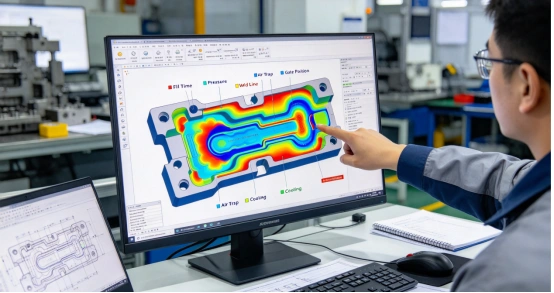
Mold flow analysis can help predict filling issues early, especially for complex or thin-wall parts.
Experienced technicians often use these methods:
A mold short shot is rarely a random defect. It is usually a signal that something inside the molding system is restricting flow, losing pressure, trapping air, or freezing the material too early.
The real challenge is identifying where the restriction begins.
In some cases, increasing the injection speed is enough to solve the problem. But for more difficult situations, the fix may involve modifying the gate size, improving mold venting, changing part wall thickness, or checking whether the machine has enough injection capacity for the application.
Effective troubleshooting in injection molding is not about randomly changing settings. It comes from understanding how melt flow, cavity pressure, material temperature, and cooling behavior work together during the filling process. Once you understand that relationship, short shots become much easier to predict—and prevent.
Related Posts



Contact Us