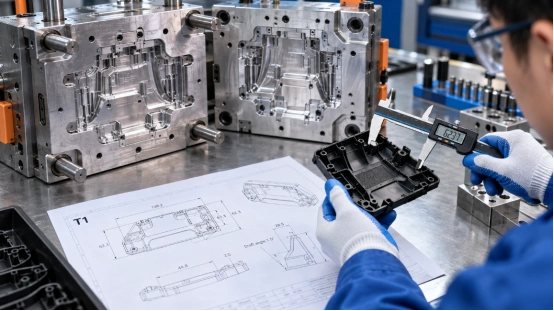
Low-Volume Injection Molding: On-Demand Production & Fast Tooling
23rd October 2026


 author
Being a great molder isn’t about memorizing machine settings.
It’s about managing the physics of the injection molding process.
Every parameter—melt temperature, injection pressure, packing, and cooling time—is interconnected. Change one, and the rest will shift with it.
If you want consistent part quality, lower scrap rates, and stable production, you need to understand how these core variables actually work together.
Primary keyword: melt temperature in injection molding
Melt temperature defines how the plastic flows into the mold.
Start with the supplier’s recommended temperature range and fine-tune based on part behavior.
A higher melt temperature can improve flow—but will often increase cooling time.
Primary keyword: injection pressure and speed
Injection speed determines how fast the cavity fills, while pressure provides the force to push material through the system.
If your machine is reaching pressure limits, check:
Primary keyword: packing pressure injection molding
After 95%–98% filling, the process enters the packing phase.
Plastic shrinks as it cools—packing compensates for this by feeding additional material into the cavity.
Holding pressure must continue until the gate freezes.
After that point, part dimensions are locked.
Primary keyword: injection molding cooling time
Cooling time typically accounts for 60%–80% of the total cycle time.
This stage determines:
Lowering chiller temperature too much → condensation on mold → part defects
Primary keyword: mold temperature control
Mold temperature directly impacts:
For semi-crystalline materials (like PA, POM):
Mold temperature also affects crystallinity, which influences long-term dimensional stability.
The biggest mistake in injection molding is treating parameters independently.
In reality:
👉 Injection molding is a closed-loop system
Once you find the optimal parameter combination:
Process inconsistency is the #1 cause of:
A disciplined, data-driven shop will always outperform one that relies on operator “feel.”
If you’re struggling with part defects, cycle time, or unstable production, it’s usually not a single parameter problem—it’s a system issue.
👉 Need help optimizing your mold design or injection process?
Visit: www.xinkeymould.com
or contact our engineering team for a professional review.
Related Posts



Contact Us