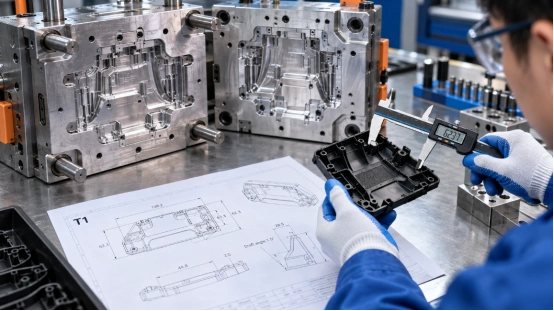
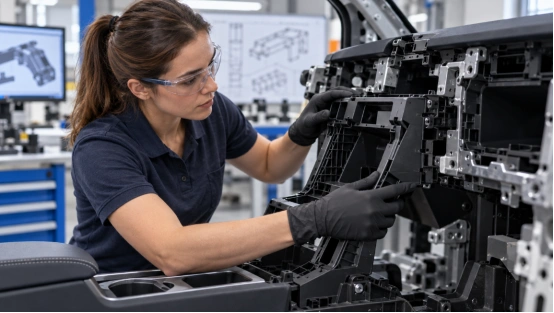
It’s funny how we obsess over every millisecond of the injection phase, yet the exit—the most stressful part of the entire cycle—is often an afterthought. Getting plastic in is one thing; getting it out in one piece is where the real engineering happens.
Mold ejection is the final hurdle.
You’ve spent the cycle filling, packing, and cooling a perfect part, but if your exit strategy is flawed, you’ll end up with stress marks, distortion, or parts stuck to the core.
Here’s why a smooth ejection is the hallmark of a well-engineered tool:
1. The Battle Against Friction and Vacuum
The moment the mold opens, the plastic part is gripping the core like a vice. As the material cools, it shrinks onto the steel—creating significant friction.
But there’s a second, invisible enemy: vacuum.
In deep-draw parts or bucket-style geometries, the part forms a seal against the core. If you rely on ejector pins alone, the vacuum will pull back against the force, causing the part to buckle or collapse.
That’s why smart tooling doesn’t rely on brute force.
Instead, solutions like:
- Air poppets
- Timed air blasts
are used to break the vacuum seal before the ejector pins even engage.
2. Balance is Everything: Avoiding the “Punch-Through”
One of the most common defects in poor ejection design is stress whitening—those visible white marks where ejector pins push too hard.
Ejection must be balanced.
If pins aren’t strategically placed around high-friction areas (like ribs or bosses), the part can:
When that happens, pins don’t eject the part—they punch through it.
A well-designed system:
- Maximizes contact area
- Distributes force evenly
- Uses solutions like stripper plates for thin-wall parts
This ensures controlled, uniform release.
3. The Silent Hero: Draft Angles
You can invest in the most advanced ejection system in the world—but without proper draft angles, you’re fighting a losing battle.
Draft is the slight taper on vertical walls. Even 0.5° can make the difference between:
- A clean release
- A stuck part requiring manual removal
And on textured surfaces? Draft becomes even more critical. The plastic effectively “locks” into the mold texture.
Rule of thumb: the more draft, the better.
4. Timing and Thermal Balance
Ejection is not just about how you push—but when.
- Too early:
The part is still soft → pins leave indentations or cause deformation
- Too late:
The part grips the core too tightly → excessive force leads to damage
Miss that window, and you’re no longer ejecting—you’re forcing failure.
Modern tooling has evolved beyond traditional mold release sprays.
Instead, many high-performance molds now use:
- DLC (Diamond-Like Carbon) coated pins
These coatings:
- Reduce friction
- Improve heat control
- Extend tool life
- Enable faster cycle times
Most importantly, they allow parts to release cleanly—without contamination or residue.
The Bottom Line
A great mold doesn’t just produce a perfect part—it produces that part consistently, automatically, and reliably.
If an operator has to stand by the machine to help parts fall out, the ejection system has already failed.
Design for the Exit
At [Your Company Name], we don’t treat ejection as an afterthought.
From:
- Stripper plate systems
- Multi-stage ejection
- Advanced coatings
We engineer every detail to ensure that each part exits the mold as perfectly as it was formed.
Because in injection molding, the final step is just as critical as the first.
如果你要,我可以帮你再优化一版更偏营销型(更适合获客)或者SEO关键词版本(适合Google排名) 👍
联系我们