Low-Volume Injection Molding: On-Demand Production & Fast Tooling
23rd October 2026


 author
A soft seal that sits half a millimeter off position can leak. A color boundary with a fine line of flash can make an otherwise good housing look cheap. These are the practical risks behind two-shot plastic injection molding tooling. Good 2K mold design controls both shots as one process, so 2K injection molding can produce a rigid body, soft grip, seal, or second color without gluing and manual fitting.
A two-shot injection mold forms two plastics during one automated cycle. You may also hear two-shot molding, two-component injection molding, or dual material tooling. A 2K injection molding machine has two injection units, one for each resin. This form of multi-material injection molding suits parts that need integrated seals, soft-touch areas, or two-color injection molding with a neat boundary.
Shot one makes the substrate. The tool then handles substrate transfer or changes the cavity around it. Shot two fills the open area, followed by cooling and ejection. Reliable cavity alignment keeps the second material where the drawing says it should be. Small errors show up fast as exposed substrate, thin seals, or flash.
The choice in 2K molding vs overmolding usually comes down to volume, registration, and budget. Two-shot production keeps the part in one automated cycle, which suits high-volume production. Conventional overmolding moves a cooled substrate into another tool and can suit smaller runs. By comparison, insert molding usually puts plastic around a prepared metal or other component.

Part shape and press layout set the architecture. Start with the actual 2K press configuration, including platen size, nozzle spacing, shot capacity, and rotary functions. Otherwise, the finished tool may not fit the press. An expensive surprise.
A rotary platen mold turns the first shot, often through 180 degrees, to the second station. This rotating mold works well when clean registration matters. A core-back mold retracts steel to open space while the substrate stays put. A shuttle mold moves it in a linear or indexed action. Each method needs firm retention, repeatable mold alignment, and safe water routing.
Strong 2K part design starts with the resin pair and ends with a tool that can repeat the same motion thousands of times. The hard problems sit at the join between materials, where heat, pressure, steel, and shrinkage meet.
Check the exact resin grades, not just labels such as PC or TPE. Additives, pigments, hardness, drying, and surface contamination can change material compatibility. Compatible polymers may use chemical bonding as the hot second shot fuses with the substrate. Other pairs need mechanical bonding through a hole, groove, rib, or wraparound mechanical interlock.
Give the bonding interface enough area and a clear flow path. The material transition should avoid knife edges and long, unsupported lips. Set a real test as well, such as peel force, leak rate, or torque. A compatibility chart is useful for screening, but a trial with production-grade resin settles the question.
Good shut-off design keeps shot two inside its intended boundary. A supported steel-on-steel shut-off needs enough land, a sensible angle, and replaceable wear areas where possible. Weak support or worn steel often causes material bleed.
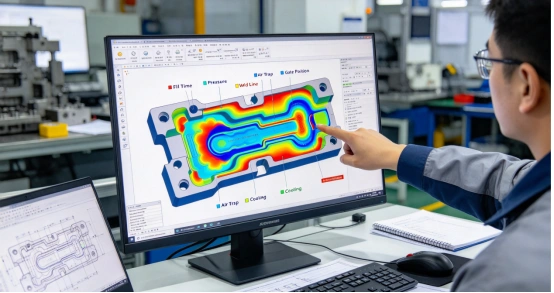
The second gate location must fill the soft or colored area without lifting the warm substrate. Good runner balance matters twice because both shots must fill evenly. A hot runner system can cut runner waste. A cold runner system may suit color changes or certain resins. Moldflow analysis can flag pressure loss, weld lines, air traps, and washout before steel cutting.
The two resins rarely cool at the same rate. Sound 2K mold cooling uses deliberate cooling channel design around both cavity states while leaving enough interface heat for bonding. Treat differential shrinkage separately for each material. One shrink factor across the whole part can produce bowing, uneven seal thickness, or a shifted cosmetic edge.
Keep uniform wall thickness where the geometry allows, add a workable draft angle, and place mold venting at the end of fill. The final ejection system should push on rigid, supported areas rather than a soft seal or clear cosmetic face.

Changes cost less before steel cutting. A proper injection molding DFM checks the material boundary, shut-offs, transfer datums, gates, draft, ejection, and press fit. A separate Moldflow analysis reviews filling, pressure, cooling, and warpage. These checks support 2K mold validation, though neither replaces a resin trial.
A T0 mold trial confirms movement, filling, retention, and release. T1 samples support dimensional, cosmetic, and bonding review. One electrical HVAC grommet project used a 2+2-cavity tool, black PC plus transparent PC, a cold runner system, and a recorded cycle near 55 seconds. Clear and black regions demand careful gate placement and balanced cooling.
A useful 2K tooling RFQ needs more than a CAD file. Send both resin grades, colors, annual volume, cavity target, texture, bond test, sealing need, critical dimensions, and acceptable gate marks. Add the machine data and tool standard.
Ask the supplier to state assumptions about 2K tooling cost and 2K mold lead time. Complex mechanisms add machining, fitting, trials, and maintenance. Project guidance places some complex 2K tools around four to eight weeks to T1, though scope can move that range. A quote without resin and press data is mostly guesswork.
The same engineering thread should run from DFM through sampling. A supplier that reviews the bonding interface, simulates both fills, builds the tool, and supports trials has fewer handoff gaps when a part peels or shifts.
XINKEY MOULD connects product review, mold engineering, precision machining, sampling, and molding support. Its documented capabilities cover 2K molds, complex sliders and lifters, hot and cold runners, and Moldflow work.
The company reports 25 years of moldmaking experience, 22 in-house designers, more than 7,000 exported mold sets, tooling from 150 kg to 15 tons, and mold sizes from 150 mm to 1,500 mm. Those details matter because two-shot plastic injection molding tooling needs mechanical design, process checks, and shop-floor correction to stay connected.
Q1: What Is the Biggest Risk in 2K Injection Molding?
A: Poor material compatibility can cause peeling, while weak shut-offs or poor positioning cause flash and offset boundaries. Test the exact resin grades and review the interface before cutting steel.
Q2: How Does a Two-Shot Injection Mold Join Two Plastics?
A: The materials may fuse through heat and polymer affinity, or the part may hold them with grooves, holes, ribs, and wraparound geometry.
Q3: Why Does Mold Alignment Matter So Much?
A: The warm substrate must arrive at shot two in the same position every cycle. A small shift can expose the first color, thin a seal, or open a flash path.
Q4: Is 2K Tooling Always Better for High-Volume Production?
A: It often cuts transfer and assembly work, but the volume must repay the more complex tool and press. Compare full production cost, not tool price alone.
Q5: What Should Be Checked before 2K Mold Design Starts?
A: Confirm resin grades, bond target, annual volume, critical dimensions, cosmetic boundary, machine layout, gate restrictions, and validation rules. Good inputs make 2K mold design far less speculative.
Related Posts



Contact Us