对工具未来的洞察

了解最新的行业趋势、技术提示和公司新闻
联系我们
cooling design.png

The Engine of the Cycle: A No-Nonsense Guide to Mold Cooling Design

  • The Engine of the Cycle: A No-Nonsense Guide to Mold Cooling Design 作者
  • 6th 5 月 2026

简介

Let’s be real: cooling isn’t just a “phase” of the injection molding cycle; it is the cycle. It usually eats up 60% to 80% of your total time on the press.

If your cooling system is an afterthought, you’re essentially leaving money on the table every time the mold opens. A well-engineered system is the difference between a high-speed production run and a “scrap-making machine” that produces warped, inconsistent parts.


Why Cooling is the “Heartbeat” of the Tool

Molds need to breathe—plain and simple. You’re forcing 250°C liquid into a tool and expecting it to become a rock-solid part almost instantly.

But if that cooling isn’t perfectly balanced, you’re in for a headache. One side freezes, the other pulls, and suddenly your precision part is curling like a potato chip.

If you’re chasing dimensional stability, you can’t just ‘hope’ for even cooling; you have to engineer it into the foundation of the tool.

Every second you shave off that cooling cycle by optimizing your “hot spots” is a direct injection of profit into the life of the mold.


Layout Strategy: Don’t Just Drill Holes

The goal is simple but tricky: get the water as close to the cavity as you dare without compromising the structural integrity of the steel.

The “Golden Rule”

We generally try to keep the center of the cooling lines about 1.5 to 2 diameters away from the cavity surface.

Too far, and the heat lingers; too close, and you risk a catastrophic “blowout” under the pressure of the injection.

Contouring is King

For flat panels, a basic grid works fine. But for complex 3D shapes, your cooling lines need to mimic the part’s geometry.

If the part is complex, don’t be afraid to look at Conformal Cooling (3D printed inserts).

Look, the upfront cost for conformal cooling is steeper, but it’s the only real way to kill those ‘unsolvable’ hot spots that a traditional drill bit just can’t touch.

It’s about eliminating the bottleneck before it eats your profit.


The Speed of the Flow

Don’t just turn on the water and assume the tool is cooling.

It’s not just about flow; it’s about turbulence. You need to hit a Reynolds number over 4,000 to actually scrub the heat off the steel.

If that coolant is just ‘lazy-rivering’ through the lines, it’s not doing its job—you’re basically just circulating lukewarm water while your cycle time suffers.


Getting into the “Dead Zones”

Deep cores and tight pockets are a cooling nightmare because you can’t just drill a straight hole into them. You’ve got to get creative with your plumbing:

Bubblers

For those deep, skinny cores where a standard drill bit is useless, we rely on Bubblers.

You’re basically sticking a tube up a blind hole to spray water directly at the ‘hot spot’ at the very tip.

The coolant hits the top and tumbles back down around the outside of the tube.

It’s the only real way to stop those narrow features from turning into heat traps that bake your plastic and ruin the cycle.

Baffles

Then you’ve got Baffles. These are essentially metal dividers you drop into a cooling line to stop the water from taking the ‘easy way out.’

By forcing the coolant to snake and churn around a curved blade, you’re maximizing its contact with the hot steel.

It’s all about making sure the water actually spends enough time ‘scrubbing’ the heat off the mold before it heads for the exit.


A Hard Truth from the Floor

If you can’t pull these inserts out to clean them, you’re in trouble.

Over time, mineral scale and gunk will calcify inside these lines.

If you don’t design them for easy maintenance, you’ll watch your cycle times slowly creep up month after month as the ‘veins’ of your tool get clogged.

Don’t wait for a total blockage to realize you should have made them easier to scrub.


Optimization: Stop the Guesswork

Don’t wait until the mold is on the press to find out it’s running hot.

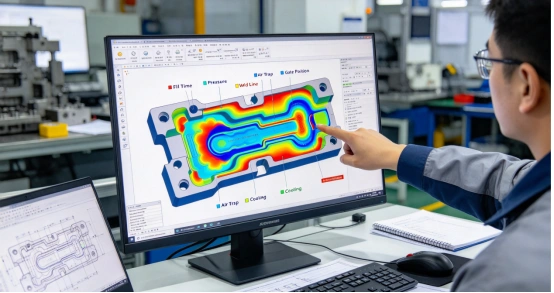
Simulate it first

Use mold flow analysis to hunt for “hot spots” before you ever cut a piece of steel.

It’s a lot cheaper to move a cooling line on a screen than it is to weld and re-drill a hardened cavity.

Watch the “Delta T”

In production, monitor the temperature difference between your inlet and outlet.

If you’re seeing a jump of more than 3°C to 5°C, your circuit is unbalanced.

One side of your mold is working too hard while the other is coasting.

Water Quality is a Tooling Issue

Scale buildup inside your lines is like high blood pressure for your mold.

Use treated water to prevent algae and mineral deposits.

If your lines get “clogged,” your heat transfer efficiency drops off a cliff.


The Bottom Line

Your cooling system is the “engine” that drives your cycle time.

Treat it like a secondary plumbing job, and you’ll pay for it in long cycles and warped parts.

Treat it like a precision-engineered thermal management system, and you’ll have a tool that runs fast, stays stable, and makes money.


Practical Takeaway

Invest in the cooling design during the CAD phase.

Shaving two seconds off a 20-second cycle might not sound like much, but over a million shots, that’s 550 hours of machine time you just handed back to your bottom line.

目录

博客

相关文章

常见问题

A: 对于标准模具,需要2-4周。根据工程深度,拧松或2K模具等复杂项目可能需要4-8周的时间。
A: 是的,我们的22名内部工程师在收到您的3D文件后24小时内提供免费、详细的DFM报告。
A: 我们根据您的特定区域或项目要求,严格遵守DME、HASCO和LKM标准。
1111

联系我们


    产品
    联系人
    WhatsApp
    电子邮件