
Low-Volume Injection Molding: On-Demand Production & Fast Tooling
23rd October 2026
 auteur
À l'ère des systèmes à canaux chauds complexes et des vannes d'injection, la vanne d'injection directe (ou « grande vanne ») est souvent perçue comme une méthode « traditionnelle ». Mais ne vous laissez pas tromper par sa simplicité : elle reste un incontournable dans tous les ateliers de moulage sérieux, et ce n'est pas sans raison.
Le principe fondamental ici est l'efficacité par la simplicité.
Comme le polymère fondu s'écoule directement de la buse dans la cavité, sans passer par un système de canaux, la perte de pression est quasi nulle. Cela fait une énorme différence lors du traitement de résines à haute viscosité comme PC ou PMMA, où la résistance à l'écoulement représente un défi constant.
Pour les pièces embouties de grande taille et à forte profondeur — telles que les conteneurs industriels ou les boîtiers robustes —, c'est souvent la solution la plus fiable pour éliminer les problèmes de manque d'emboutissage.
Parce que cela ne nécessite qu'une norme structure de moule à deux plaques, cela contribue également à maintenir :
Bien sûr, chaque conception comporte des compromis.
L'inconvénient le plus visible est le cicatrice de porte— un moignon épais et saillant qui nécessite généralement un ébarbage secondaire (découpe manuelle ou par commande numérique). Cela le rend inadapté pour :
Cependant, le problème majeur se cache sous la surface : déséquilibre thermique.
La zone de la grille retient la chaleur beaucoup plus longtemps que le reste de la pièce, ce qui peut facilement entraîner contrainte résiduelle.
Si la configuration du système de refroidissement n'est pas bien optimisée :
Pour les pièces cylindriques ou tubulaires, une attention particulière est nécessaire pour lignes de soudure circulaires. Le centrage par le centre peut introduire des points faibles structurels cachés qui ne deviennent apparents que sous charge.
En atelier, ces dimensions ne sont jamais devinées ; elles sont calculées en fonction des propriétés des matériaux et des spécifications de la machine.
Cela doit correspondre au diamètre de la buse de la machine :
Plage typique : 2.5 – 4.0 mm
Un tirage correct est essentiel pour le démoulage :
Une conicité insuffisante peut entraîner le collage du canal d'injection, augmentant ainsi le temps de cycle et le risque de défauts.
Principe de conception : plus court, mieux c'est
Des carottes plus longues entraînent :
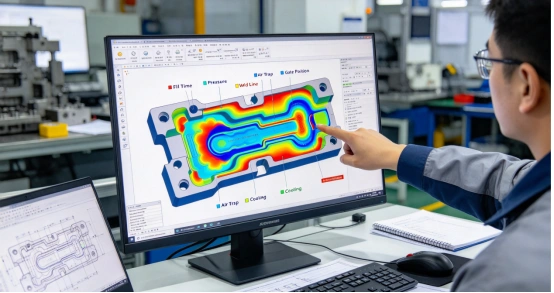
Lors de l'analyse Mold Flow sur les conceptions à injection directe, l'attention se porte au-delà du simple comportement de remplissage.
Principaux domaines à surveiller :
Si une accumulation excessive de chaleur est détectée au centre, des ajustements doivent être apportés :
Cela contribue à prévenir des défauts tels que marques de retrait et la concentration des contraintes internes.
Quand faut-il utiliser un canal d'injection direct ?
Il est idéal pour :
Toutefois, pour les projets nécessitant :
Il est préférable d'envisager des alternatives telles que :
À [Nom de votre entreprise]Chaque projet est évalué individuellement afin de garantir que la conception de la porte corresponde aux exigences de performance de la pièce, et non pas seulement à ce qui est le plus facile à fabriquer.
Articles connexes



Nous contacter